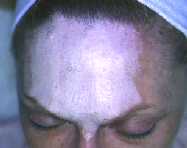
A classic TCA can only be carried out after several weeks’ preparation of the skin with the aid of tretinoin (to make the acid penetrate more uniformly) and anti-tyrosinases (to limit the pigmentary re-emergence due to the classic TCA). Easy TCA, on the other hand, can be applied to a non-prepared skin, because the acid and the post-peel cream penetrate uniformly and control pigmentary re-emergence.
A classic TCA must be carried out on a perfectly degreased and clean skin, while the skin should not be degreased or cleansed prior to using Easy TCA.
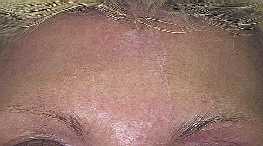
A classic TCA must provide a uniform whitening of the regions treated (see photograph above) or else the results will be irregular, while the Easy TCA base protocol allows the application of the acid to be stopped once the first spots of whitening appear (see photograph below ).
A classic TCA only begins to be truly effective at a concentration of 25% weight for weight, while Easy TCA provides the same benefits at concentrations of less than 15%.
A classic TCA is painful and, depending on the concentrations used, will call for administration of an analgesic or truncal blocks, that is, neuroleptanalgesia, while Easy TCA causes only a slight stinging or burning sensation, requiring no analgesia. Furthermore, and even though it does not neutralize the TCA, the post-peel cream immediately and permanently relieves that stinging sensation.
The choice of the correct concentration is one of the problems to be faced before carrying out a classic TCA: should we use 20%, 30%, 35% (w/w, w/v, w+v)? The concentration of Easy TCA is fixed and so releases the practitioner from having to choose.
The choice of depth of action of the classic TCA is another problem as well: is the acid working at the surface level, in the papillary dermis or reticular dermis? Easy TCA also releases the doctor from making this choice, since most cases can be treated using the base protocol (application of the acid solution in successive layers that are left to dry until the first spots of proteocoagulation appear, as shown by spots of whitening).
The post-peel of the classic TCA is unpleasant for the patient, who has to put up with a tough week full of oedemas, scabs, erythema, pain and other discomfort. Social life is absolutely impossible during this first post-peel week and can only be resumed after that period, and with heavy make-up. The skin’s return to a normal state takes several weeks. Easy TCA, on the other hand, permits a practically normal social life, since the flaking it produces is no worse than a sunburn and lasts only 48-72 hours.
The classic TCA must be repeated several times, at intervals of at least one month, when skin aging is visible, and in any case its results are less than those of a phenol peeling. Easy TCA does not claim to produce the same results than a phenol peeling, but the base protocol can be repeated without danger four times, once a week, for deeper effects.
Pigmentary "rebounds" (post-inflammatory hyperchromia) are the most frequent complication of classic TCAs, which is why lengthy pre-peel preparation is necessary along with the preventive use of anti-tyrosinase products, pre- and post-peel. Easy TCA presents an incredibly low rate of pigmentary reactions and indeed, when the base protocol is used and repeated four times, it is extremely rare for such problems to appear, even on dark or Asian skins.
Herpes simplex is an absolute contraindication for classic TCA and is a relatively frequent complication, while herpes in post Easy TCA occurs no more than it does in the normal population.
If carried out down to the reticular dermis, the classic TCA brings a risk of prolonged erythemas which can become scars. The Easy TCA base protocol entirely prevents such problems.
The classic TCA can only be applied on skin free from excoriation, while the Easy TCA base protocol can be applied on skins with acne or even immediately after electrocoagulation of telangiectasias, electric epilation or high-frequency treatments to avoid scabs.
In more general terms, a classic TCA consists in applying a strong acid solution onto the skin to destroy the skin’s proteins and then waiting for the natural regeneration process to replace the destroyed dermal-epidermal layers. The dermal reaction is more of a scarring reaction. Easy TCA, on the other hand, is stimulating rather than destructive and has to be repeated several times at about one-week intervals, so that each peeling revives the stimulation achieved in the previous session.
Finally, it should be remembered that a classic TCA sets off inflammatory processes that rapidly generate large amounts of free radicals, and these free radicals in the dermis and epidermis damage the cells which are supposed to regenerate the skin.
The Easy TCA cream which when applied immediately after the peeling penetrates rapidly into the skin due to the increased cutaneous permeability caused by the acid solution, is made up of numerous anti-free radicals and other ingredients which absorb the oxidants produced by the inflammatory reaction, thus breaking certain vicious circles that maintain the inflammation and the production of free radicals.
In short, Easy TCA has many decisive advantages when compared with the classic TCA.